
You can remove some fake reviews, but not always. The right approach is to act quickly by flagging clear violations, escalating when needed, appealing decisions, and using platform and network channels to push for removal. If handled the wrong way, the situation can spiral out of control and cause real damage. And when handled correctly, you can contain it and recover.
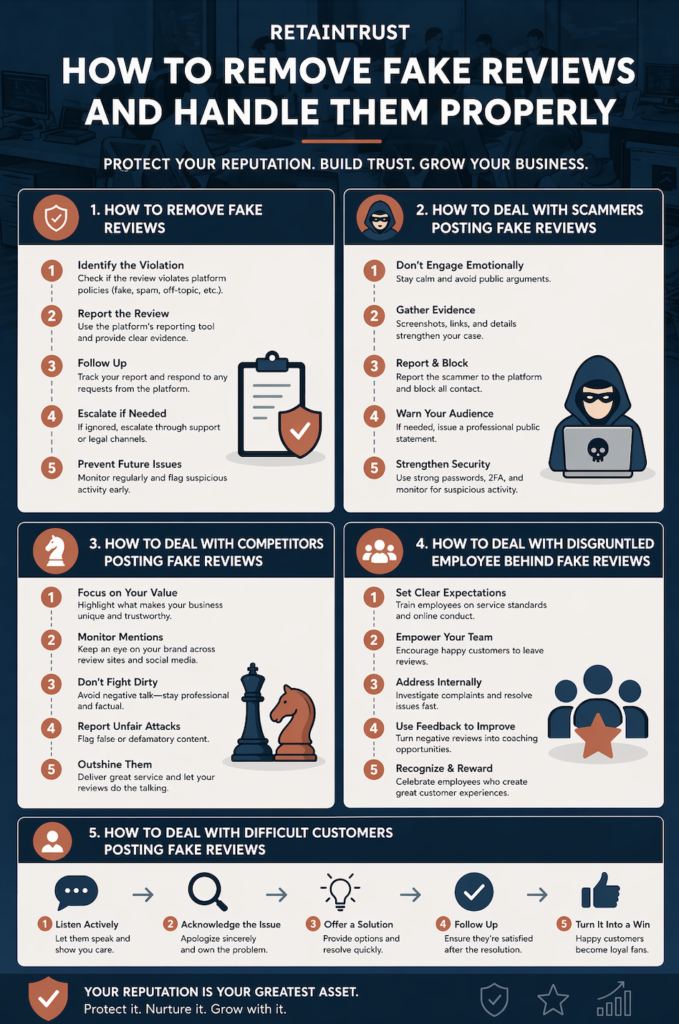
Fake reviews show up in different forms and shapes, and not all are obvious at first glance. Some come from real customers or former employees who escalate a single issue into exaggerated claims or multiple reviews on the same platform. Others can be coordinated competitor attacks designed to boost their profiles and damage yours, it happens a lot in the local markets. And there are also low quality (but with AI it can be hard to spot well written ones), often templated reviews tied to extortion attempts, followed by calls demanding payment to take them down. Each type requires different response we are going to discuss.
How to Report and Remove Fake Reviews
Each review platform handles removal requests differently, but the core process is similar. Here is a simple framework you can use to flag and escalate fake reviews across most platforms:
- Identify Fake or Review in Question
- Analyze the Content. Look for common signs of a fake review, such as bad grammar, lack of specific details about the product or service, similarly worded reviews, AI-generated, or inconsistencies in the reviewer’s history.
- Check Reviewer Profile. Investigate the reviewer’s profile to see if they have a pattern of leaving similar negative reviews, or if their account seems suspiciously new.
- Gather Evidence
- Document the Review in Question. Take screenshots of the fake review and any additional relevant details that may support your claim. For example communication record, transaction logs, reviews on other platforms written by the same individual.
- Collect Supporting Information. Gather any additional evidence that shows the review is not genuine or fake, such as proof that the reviewer never interacted with your business in the past.
- Report the Review
- Locate How to Report. Find the reporting or flagging tool or link on the review platform. This is typically found next to or below the review, or go to “contact us” or “support” page.
- Research Platform Guidelines. Each platform has its own content rules and guidelines for reporting reviews. Follow these guidelines to increase chances for successful removal.
- Provide Specific Details and Evidence. Clearly and professionally explain why the review is fake and provide any evidence you have.
- Follow Up
- Submit Appeal. Almost every platform has appeal functionality if the review wasn’t removed after first attempt.
- Contact Support. If the review is not removed or if you do not receive a response, try contacting the platform support for further help.
Best Practices for Reporting Fake Reviews
Follow these best practices to report fake reviews and increase the chances they get removed
- Gather Evidence. Collect screenshots, transaction records, or communication logs that support your claim.
- Be Specific. Clearly articulate why the review is fraudulent and detail how it violates the platform rules.
- Follow Up. If the review is not removed, contact the platform’s support team to escalate the issue and request a deeper review.
- Persistence Pays. Stay persistent when dealing with fake reviews. It often takes multiple reports and follow-ups before action is taken.
- Maintain Professionalism. Approach all communications with the platform’s moderators in professional manner to maximize your chances of a positive outcome.
Keep in mind that review networks are typically monitored by real human moderators who review reports to determine if reviews are real or fake, and whether they violate the platform’s guidelines. By following the steps listed above, you can improve your chances of persuading moderators to support your case.
Mistakes to Avoid When Dealing with Fake Reviews
Dealing with fake reviews requires a careful approach to avoid common mistakes:
- Insufficient Evidence and Emotional Appeals. It’s important to gather clear evidence before reporting a fake review. Emotional appeals or reacting impulsively can weaken your case.
- Posting Fake Positive Reviews. Attempting to counteract negative reviews with fake positive ones can backfire.
- Avoid Replying to Fake Reviews. Engaging with fake reviews through replies is generally discouraged. Responding defensively can validate the fake review in the eyes of potential customers.
- Replying to a fake review can actually make it more visible. When you engage with it, you add signals that platforms may treat as relevance, which can push the review higher and keep it featured. That visibility can also carry over into search engines and AI recommendations. Instead, focus on flagging and reporting it through the platform’s official channels.
- Don’t Retaliate or Escalate. All fake reviews should be flagged and reported. Avoid the temptation to engage directly with the reviewer or retaliate, as this can escalate the situation.
How to Escalate a Fake Review That Won’t Be Removed
If you find that a fake review cannot be removed through the usual reporting channels on the platform, there are several steps you can take:
- First, try escalating your case within the review platform’s support team, use contact form.
- Second, post on the platform’s official forums. Moderators often monitor these spaces and can step in to review the issue or take action.
- Third, reach out through the platform’s social media channels. They sometimes respond there and can step in to review.
- Lastly, in forum groups and on social media, look for people who have the same fake review issues. Join their discussions, share your situation, and tag the platform or its moderators to bring more attention to your case.
Sometimes, a different department or higher authority can assess the situation and take actions. If this doesn’t work, consider seeking legal advice, especially if the fake review crosses into defamation and violates laws.
Why You Should Never Pay Scammers to Remove Fake Reviews
If you run into scammers posting fake reviews and then asking for payment to remove them, ignore. Don’t reply, don’t negotiate, and don’t pay! These campaigns are usually opportunistic. They post random reviews and send the same message to many businesses and wait to see who responds. If you ignore, they usually don’t waste time and move on.
Once you reply, you signal that there’s someone on the other end. You become an “active lead” for them, a “new client”. That can turn you into a repeat target. It often leads to more messages, more fake reviews, and often your contact details getting passed around and sold to other bad actors.
Paying doesn’t solve it either. In many cases it does the opposite, it confirms their approach works and gives them a reason to keep coming back for more.
The safest move is to ignore them, report fake reviews they already posted, try to take them down and hope they never come back, most likely they won’t if you never contact them, reply, respond, or pay. Report the reviews through the platform, document everything, and keep pushing through the proper channels. Most of these actors lose interest when they don’t get a response.
Fake Review Reply Examples. How to Respond to Fraudulent Negative Reviews
Avoid replying to fake reviews. It can make them look more credible and increase their visibility in platform algorithms, search engines, and AI recommendations. Focus on reporting and escalation instead.
However, if you have exhausted all attempts to flag and remove and still feel compelled to respond, it’s important to do so professionally and very carefully.
In your decide to leave response to a fake review, highlight the fact that there is no record of a transaction, interaction, or service with the person in question.
Examples of How to Reply Diplomatically to Fake Reviews
Example #1:
“Thank you for sharing your feedback. We take all customer reviews seriously. Upon reviewing our records, we couldn’t find any transactions or interactions matching your feedback. Please feel free to reach out to our customer service team at [contact information] so we can resolve this matter promptly. Thank you for understanding.”
Example #2:
“We appreciate your feedback, unfortunately we are unable to identify your visit based on the information provided. We are dedicated to providing exceptional service and experiences to all our patrons. Please reach out to us directly at [contact information] so we can work towards a resolution. Thank you for your understanding and for allowing us to address this.”
Example #4:
“Thank you for taking the time to provide feedback. We are dedicated to delivering exceptional service to all our customers. Upon thorough review of our records, we are unable to verify your visit or interaction with our establishment. Please connect with our customer support team at [contact information] so we can assist you personally.”
For more examples on managing and responding to negative reviews, check out our other blog post: Responding to Negative Reviews Online.
How to Handle a Competitor Posting Fake Reviews
When a competitor is posting fake reviews, it happens often in local markets where businesses compete for the same customers such as laundry services, lawyers, contractors, or other professional services… it’s important to handle it carefully and directly.
If you can clearly identify the person or business behind the reviews:
- Contact them directly and ask them to stop
- Speak with a legal professional
- Send a cease and desist letter
- Consider legal action if the behavior continues
But in most cases, it’s difficult to prove who is behind the reviews, even if you have strong suspicions. In that situation, focus on working with the platform:
- Report the fake reviews, but this may only be a temporary fix if new ones are posted by the same person
- Contact the platform directly and explain the pattern, some can monitor your account more closely and be more vigilant approving new reviews
How to Handle Difficult Customers Posting Fake or Exaggerated Reviews
Every business eventually runs into this at some point, a difficult customer, or as they call a “customer from hell”, who exaggerates, twists facts, or posts multiple complaint across all platforms like Google Reviews, Yelp, or Trustpilot etc. The mistake most businesses make is reacting emotionally. That usually makes things worse.
We start with not to do because dealing with this type of customers almost always backfire:
- Don’t get into a back-and-forth
- Don’t accuse the customer publicly of lying
- Don’t try to “win” the argument in the review section
What actually works:
- Stay consistent and professional in your responses
- Let real customer feedback outweigh
- Understand that most readers can spot an unreasonable review
What to do:
- Respond once. Keep it short. Acknowledge the concern, state the facts
- Don’t argue or respond emotionally
- If possible, take it offline. Offer to resolve the issue privately.
- Report violations to the network. If the same review is posted multiple times or contains false claims, flag and appeal it. Platforms don’t always remove content, but duplicates and misleading statements have a better chance.
- Document everything. If things escalate, this matters.
How to Handle Disgruntled Employees Posting Exaggerated or Multiple Reviews
When a current or former employee posts negative reviews, it can be personal. In some cases the issue isn’t just one bad critical review, it can be a pattern: exaggerated claims, emotional language, or often multiple reviews across the same platform intended to drag down your star rating. This is especially common on platforms like Glassdoor, Indeed, or Google Reviews where identity verification can be limited. The key is to respond strategically, not emotionally.
If you can identify them:
- Address it through HR, whether the employee is still with the company or has already left under a signed severance agreement
- Reach out calmly (if possible) to de-escalate
- Review contracts or policies (NDA, false statements, severance agreement)
- Consult a legal professional if claims are defamatory
If you don’t know who posted or can’t prove it:
- Focus on patterns (duplicates, suspicious timing, repeated language)
- Report reviews, especially duplicates or misleading content that violate network’s policies
- Contact the platform and explain the pattern
- Document everything (screenshots, dates, links, communication)
Fake Reviews Come at High Cost for Businesses
According to the World Economic Forum, online reviews are projected to influence $3.8 trillion in global e-commerce spending. The issue of fake reviews has become so severe that in 2024, the FTC announced plans to work toward banning fake reviews and testimonials.
Online Reviews Breakdown, 23% Are Likely Fake
According to RetainTrust research analyzing online reviews across platforms like Google, Yelp, Glassdoor, Trustpilot, and TripAdvisor, approximately 23% of reviews are suspected to be fraudulent.
How to Spot Fake Reviews
Knowing the different types of fake reviews helps you spot them faster and deal with them more effectively:
- Poorly Written Reviews. Reviews with grammatical errors, content that doesn’t make sense, or incoherent language may signal fake reviews written in hurry, not putting too much thought, or by individuals not proficient in the language.
- Broad and Too Generic Feedback. Reviews that are overly broad or lack specific details about products, services, or real customer experiences may be indicators of fake reviews. Sometimes those reviews have as little feedback as “bad customer service”, or “this company is scam”, or nothing written at all but 1 star rating. Genuine reviews typically include specific information relevant to the customer real interaction.
- Bot and AI Generated Reviews. Reviews generated by AI automated bots with lack authentic human experiences and often use generic repetitive language. These reviews can appear in large numbers within a short period, with goal to manipulate ratings.
- Non Genuine Reviews. These reviews do not reflect real customer real experiences and may be vague, overly positive or negative without specific details.
- Dishonest Reviews. Reviews containing false information or even lies about a business can severely damage its reputation. These reviews may be motivated by personal vendettas, competition, or extortion.
- Multiple Accounts. Individuals or entities create multiple fake profiles to post reviews, inflating or deflating a business ratings. This tactic aims to deceive potential customers about a business’s reputation and star ratings. Those accounts often new, have no history writing previous reviews, don’t appear to be active in the future.
- Sudden Influx of Reviews. A sudden surge in reviews, especially if they are uniformly positive or negative, can indicate orchestrated efforts to manipulate public opinion and ratings. These reviews often lack consistency or genuine feedback.
Understanding these common types of fake reviews helps businesses to proactively monitor and address fraudulent feedback, safeguarding their online reputation and maintaining trust with customers.
Example of a Fake Review
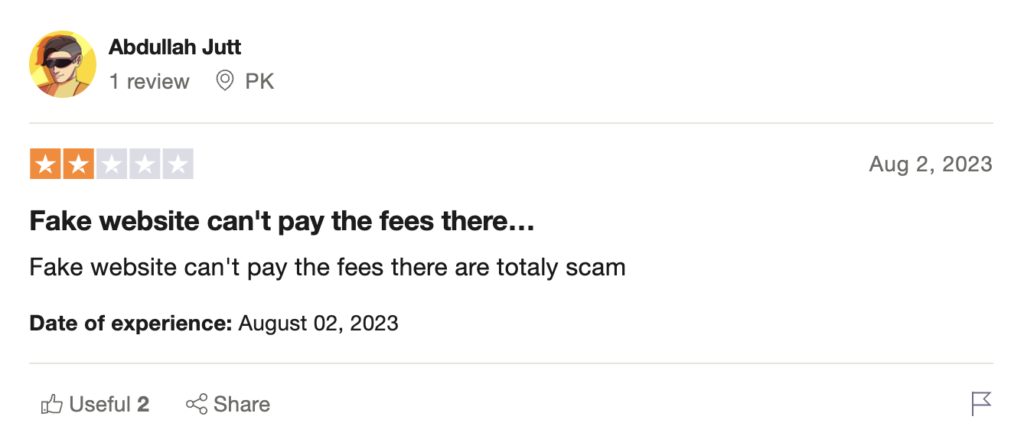
A typical fake review that came from “PK” (Pakistan), a location where the business doesn’t operate. The review has generic text, grammar mistakes, and irrelevant information, and came from a non-established account. It appeared together with other similar reviews around the same time. To avoid detection, scammer gave 2 stars knowing that 1 star reviews may raise more suspicion of being fake.
My Final Thoughts
Fake reviews aren’t going anywhere and they’re evolving. What used to be easy to spot (bad grammar, obvious patterns, obvious spam) is now getting polished by AI, making fake feedback look just convincing as real ones.
If you want to win, stay vigilant, be patient, and don’t argue or respond with ghosts on the internet, they usually have more free time than you.