
Online reviews directly influence consumer decisions, business reputation, search rankings, AI recommendations, and revenue. The rise of fake reviews, AI content, and low-quality feedback has made it harder to trust what people see and read online. Businesses, bots, and bad actors often manipulate reviews to boost star rankings or damage competitors, creating a major trust problem across platforms.
To understand the scale of the problem, RetainTrust conducted analysis of reviews across major platforms including Google, Yelp, Glassdoor, Trustpilot, and TripAdvisor. The study compares genuine and fake reviews, identifying patterns, quality differences, and their impact.
Research Report on Real vs Fake Reviews Distribution Data
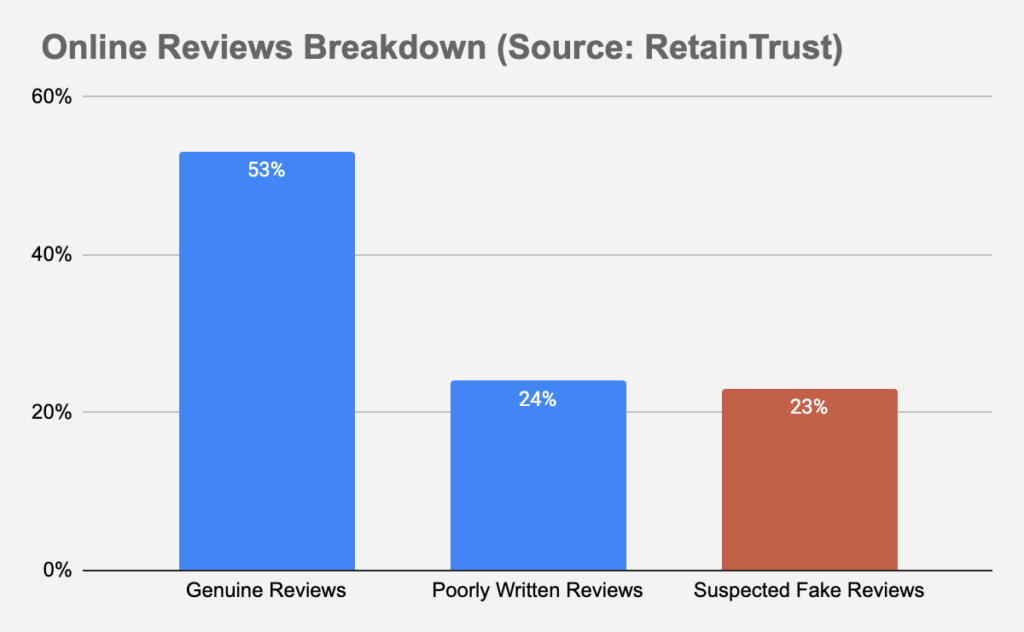
- Genuine (Real) Reviews: 53%
- Poorly Written Reviews: 24%
- Suspected Fake Reviews: 23%
Overview of the Research
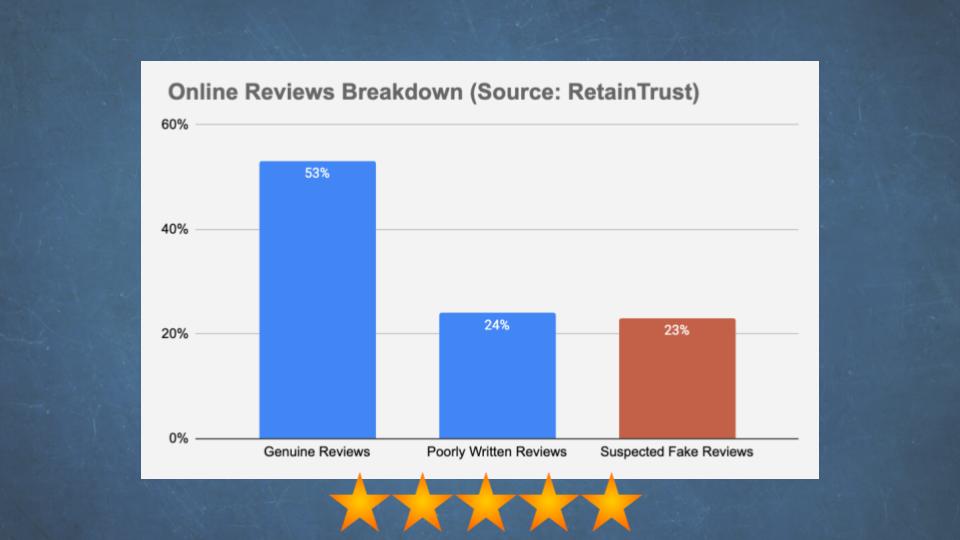
According to research, approximately 23% of the reviews are suspected to be fraudulent or fake. Additionally, another 24% of the reviews were poorly written or lacked genuine details about products, services, or real interactions with businesses. Meanwhile, 53% of the reviews were found to be genuine and provided useful details.
Methodology of the Research
To provide a clear understanding of the authenticity of online reviews, RetainTrust conducted an analysis of reviews that appear across five most popular reviews platforms, including Google, Yelp, Glassdoor, Trustpilot, and TripAdvisor. The study involved researching 30 companies on each network and analyzing reviews left by customers, clients, and employees. These companies were selected to represent a diverse wide range of industries, including B2C eCommerce, B2B technology companies, bank branches, medical offices, car dealerships, law firms, real estate agencies, restaurants, bars, hotels, and local businesses such as chiropractors, dentists, dry cleaners, maintenance services and others. The goal was to differentiate genuine reviews from those that are fake, fraudulent or poorly written.
Determining Genuine Reviews
Reviews were classified as real based on several criteria:
- Reviews that included specific, verifiable details about the business, product, service, or experience.
- Reviews written in natural consistent language.
- Reviews from established accounts with a history of multiple reviews and consistent activity.
- Reviews that were relevant to the business or service being reviewed, showing firsthand experience.
- Reviews that included both positive or negative aspects, providing different perspective.
- Reviews linked to verified purchases or services.
- Reviews that received replies and follow ups from businesses
Determining Fake Reviews
Reviews were classified as fake based on several criteria:
- Poorly written with numerous grammar mistakes
- Lacked genuine details or experiences
- Reviews from bots and AI generated content
- Repetitive patterns
- Came from new accounts without any other activity
- Sudden influx of a large number of positive or negative reviews in a short period
- Positive reviews written like self promotion with clear intention to boost star rankings
- Negative reviews designed to lower rankings without providing genuine information
- Were marked by the network as suspicious or hidden
Identifying Poorly Written but Genuine Reviews
- Came from established accounts with real profiles, avatars, and multiple reviews for different companies
- Were short and lacked detailed information about product, service, or business itself
- Contained grammar mistakes or inconsistent information
- Were emotional, dismissive, or rude without much detail
- Praised the business without specific details
- Only provided a star rating without additional information, empty descriptions
Data Collection
The study analyzed reviews from 30 companies on each platform, covering a diverse mix of local, national (US, Canada, and UK), and global businesses. Including small businesses, mid-sized companies, and large enterprises. In total, more than 2,700 reviews were examined. Clear and consistent patterns began to emerge after approximately 1,500 reviews, indicating that additional data would be unlikely to significantly change the overall findings.
Networks Analyzed
To distinguish between real and fake online reviews and gain better understanding, we selected the five most popular networks known for their large, loyal review communities. These platforms host most online reviews and attract significant traffic from potential customers researching businesses, products, and services. These networks include:
- Google My Business (Goole Maps) – platform by Google that allows businesses to manage their online presence across Google services, including Google Maps and Google Search. Reviews on Google are visible to anyone searching for businesses, and they play an important role in influencing consumer decisions.
- Yelp – is a review platform focused on local businesses, including restaurants, retail stores, and services. It is known for large community of regular and loyal reviewers.
- Glassdoor – job platform that allows current and former employees to review their employers. It provides insights into company culture, leadership, salaries and benefits, interview processes.
- Trustpilot – review platform that allows consumers to review businesses across various industries.
- TripAdvisor – travel review platform that provides reviews of hotels, restaurants, attractions, and other travel related businesses and services.
The diverse networks analyzed in the research, Google My Business (Google Maps), Yelp, Glassdoor, Trustpilot, TripAdvisor, were chosen by RetainTrust to provide a comprehensive understanding of the prevalence and characteristics of fake versus real reviews across various online platforms. Each network has distinct user bases and types of businesses, offering various insights and patterns of review authenticity.
By analyzing these platforms, we aimed to capture a broad range of review behaviors and discover common patterns, issues, and practical ways to spot and manage fake, fraudulent, and low-quality reviews. This ensure the findings are both reliable and relevant across various platforms and industries, making the insights useful not just for this study but for other similar networks as well.
Timeline of the Research
The research was conducted in May and June 2024. The reviews analyzed were written anywhere from 2009 to 2024.
Analyzing the Results
In our analysis of online reviews across different platforms, the goal was to uncover the authenticity and reliability of customer feedback. These findings provide valuable insights into the landscape of online reputation and consumer trust:
Genuine Reviews (53%)
A large portion of the reviews, 53%, were identified as genuine or real. These reviews demonstrated clear and specific feedback about the business, product purchased or service provided. They often included personal experiences, detailed observations, and opinions, providing a reliable source of information for future customers.
Poorly Written Reviews (24%)
Approximately 24% of the reviews were categorized as poorly written. Unclear if genuine or fake, these reviews often contained grammatical errors, lack of coherence, vague feedback, or just star rating with no content at all. While not necessarily fake, the quality of these reviews diminished their overall value for potential customers.
Suspected Fake Reviews (23%)
Around 23% of the reviews were suspected to be fake. These reviews displayed common characteristics of fraudulent content, such as overly positive (self promotion) or negative tones, generic language, repetition of phrases, copy and paste from other reviews, and/or suspicious timing (e.g. a sudden influx of reviews).
Additional Insights Into Reviews from Our Research
Our research has uncovered a range of significant issues within online review platforms, showing various patterns and practices that impact businesses and consumers alike. Here some trends and challenges we identified, offering deeper insights into the dynamics of online reviews.
During our investigation, we discovered further details, patterns, and specific issues within certain networks:
- Fluctuating Review Patterns – we observed sudden spikes in both positive and negative reviews. While many were found to be fake, occasional spikes in genuine reviews indicated businesses might be asking and running campaigns to encourage customers to leave feedback.
- Review Bombing -businesses are vulnerable to coordinated attacks of fake reviews, often in response to isolated incidents, news coverage, or viral events.
- Yelp Filtering Issues – Yelp platform sometimes mistakenly hides legitimate reviews.
- Employee Discontent – on platforms such as Yelp or Glassdoor, disgruntled employees occasionally post excessively negative reviews, sometimes exaggerating real issues.
- Sophisticated Fake Reviews – some fraudulent reviews are well written, appearing authentic. These often include positive reviews posted by businesses or their employees to improve their ratings.
- Competitive Sabotage – competitors or dissatisfied customers may maliciously post multiple fake negative reviews to tarnish a business reputation.
Our findings underscore the difficult landscape of online reviews, where authenticity can be obscured by a variety of factors, from well-organized review campaigns to deliberate attempts at sabotage. Businesses navigating these challenges must remain vigilant in monitoring and responding to all reviews while platforms continue refining their filtering systems to promote full transparency.
Conclusion of RetainTrust’s Research on Genuine vs. Fake Reviews
RetainTrust’s research reveals the significant issue of fake and poorly written reviews across major online platforms. By analyzing over 2700 reviews from 30 diverse companies, the study reveals that 23% of reviews are suspected to be fraudulent and another 24% are poorly written, lacking genuine details. This leaves only 53% of reviews as truly authentic and useful for consumers and businesses.
Economic Implications of Fake Reviews
Combatting fake reviews can come at significant costs and operational disruptions for businesses. Resources are often diverted to internal reputation management or professional services for monitoring, removing, and responding to fraudulent reviews. Legal advice and fees may also be necessary for addressing defamation or extortion attempts. Moreover, businesses may need to increase marketing investments to rebuild customer trust, reputation, and sales. Operationally, managing fake reviews takes valuable time and resources from core business activities, impacting productivity and customer acquisition efforts.