
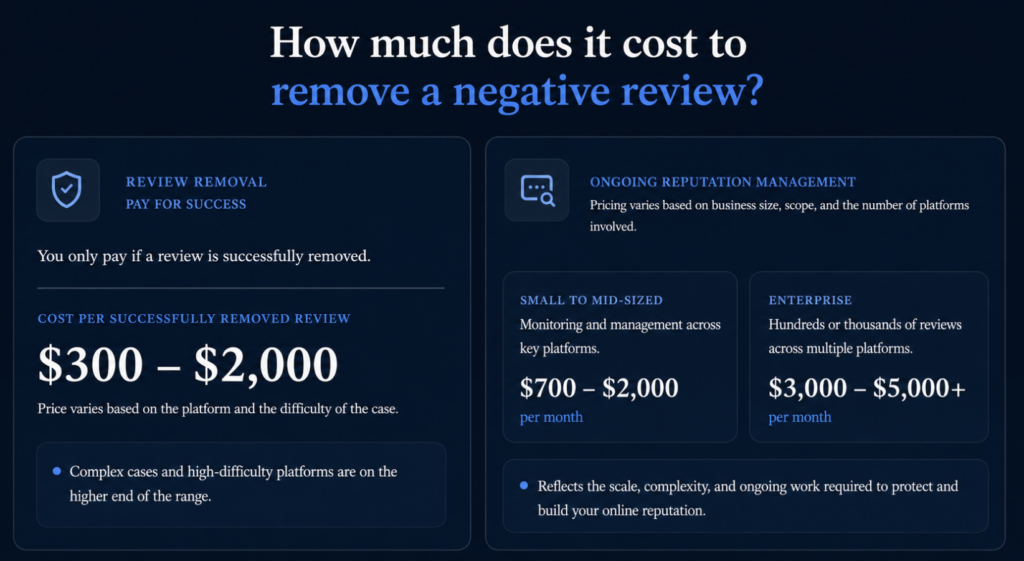
Review removal agencies often claim they operate on a “pay for success” model, meaning you only pay if a review is successfully removed. Fees typically range from $300 to $2,000 per removal, depending on the complexity of the case.
Let’s break down how this actually works, which cases agencies accept under this model, and how they determine pricing. Hint, they don’t always accept the case.
How the “Pay for Success” Model Really Works
Review removal companies evaluate each case carefully before agreeing to take it. They don’t automatically accept every request under a contingency or “pay for success” model. In reality, they often decline (sometimes majority) cases where the reviews appear legitimate and do not violate platform guidelines.
A common scenario, business owners first remove the obvious violations, so called the “low-hanging fruit”. Then they approach an agency expecting it to remove more difficult reviews that are genuine. At the same time they expect to pay nothing unless the agency succeeds at the task that is impossible at the first place.
In reality, agencies are not relying on hidden tricks or loopholes to remove valid reviews. And if loopholes occasionally appear, and it happened before, they are normally not long lasting and can backfire. If a review doesn’t violate platform rules, the likelihood of removal is low, no matter of who submits the request. Because of this, agencies avoid taking on weak cases under a “pay-for-success” model.
The structure is very similar to contingency-based lawyers. Law firms take on cases where the probability of success is high and if the odds aren’t there, they pass.
How Agencies Evaluate Cases Before Accepting Them
Before taking on a case, a reputation management agency carefully reviews the company’s existing reviews and makes assessment. Based on their analysis, they decide if the case qualifies for a “pay for success” model.
If they can’t identify reviews that clearly violate platform guidelines, or at least have angles that can be reasonably challenged through appeals, they will typically decline the contingency approach. As alternative, an agency will provide an honest assessment and recommend other strategies that may fit better.
Pricing Structure for “Pay for Success” Review Removal
When an agency agrees to work on a “pay for success” model, the cost ranges from $300 to $2,000 per successfully removed review. Price varies based on the platform, the difficulty of the case, and (often) the type and location of the agency you’re working with.
Agencies based outside the US, EU, or other high GDP countries often charge on the lower end, sometimes $300 or even less per removal. On the other side, agencies in the US and similar markets typically charge no less than $500 to $750 per review.
Platform also plays a big role. Reviews on networks like Indeed may be less expensive to remove, while high demand platforms such as Glassdoor or Google can be more expensive.

When Agencies Make Exceptions to the Model
The exceptions can happen when an agency takes on a case despite uncertainty. This usually happens when they see long-term value in the relationship, the opportunity “too big to pass”, and are being engaged for additional services such as digital marketing, design, PR, or reputation management. In those situations, review removal may be included as a “goodwill effort”, even without guaranteed success.
Alternatives When “Pay for Success” Isn’t a Fit
When an agency declines a “pay for success” case, often because the reviews don’t clearly violate rules, they’ll often recommend alternative strategies.
One common option is ongoing reputation management. This includes taking control of your review profiles, writing professional responses to existing reviews, monitoring new reviews, and helping generate positive reviews from satisfied customers.
In some cases business owners still want to pursue removals, even when the odds are low. Some agencies will agree to make another attempt as a “long shot”, but for a fee, not under a contingency model. They may charge hourly rates (typically $100 to $200 per hour) or a flat fee per review (around $200) regardless of success to handle reporting, monitoring, and appeals. And if the reviews is removed, an additional success fee may still apply.
Reputation Management Pricing Explained
For businesses that move forward with ongoing reputation management, pricing varies based on size and the number of reviews and platforms involved.
Small to mid-sized businesses typically pay between $700 and $2,000 per month for monitoring and management across a few key platforms like Google, Yelp, Trustpilot, Glassdoor and others. Larger or enterprise-level companies, especially those with hundreds or thousands of reviews across multiple platforms, can expect pricing of $3,000 to $5,000 per month or more.
Red Flags When Hiring an Agency
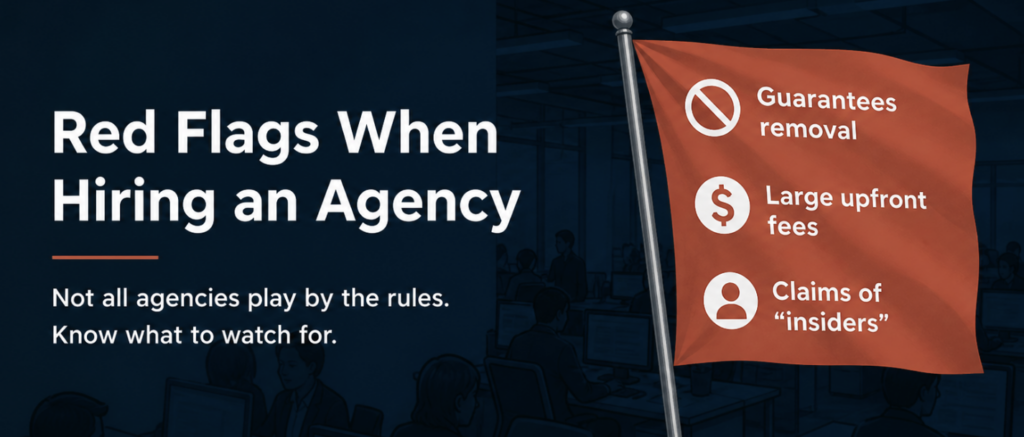
Watch for agencies that guarantee removal of any review regardless of content, charge large upfront fees before evaluating your case, or claim to have so called “insiders” at Google or Yelp. No legitimate agency has a back channel to platform moderators, removals happen through formal reporting processes, and anyone suggesting otherwise is overselling. A real agency will do a case assessment first, tell you honestly when your odds are poor, and won’t push you toward paying when your odds are low.
The Price Tag on Your Online Reputation (And Why It’s Not Cheap to Clean Up)
Review removal isn’t glamorous work, but neither is watching a three star average rating slowly sink your business while a fake review from “John Doe”, who has never set foot in your building, sits at the top of your Google page.
Yes, removing a single problematic review can cost anywhere from $300 to $2,000, and ongoing management runs $700 to $5,000+ per month, and there are no magic buttons, no secret handshakes with Google or Glassdoor, and no agency on earth that can guarantee results on reviews that don’t actually break any rules. What you’re paying for is expertise, persistence, and an honest assessment of what’s actually works. The alternative for business owners is to spend weekends furiously clicking “flag as inappropriate” and wondering why nothing happens.